Levantine LivesA Historical Atlas of Christian Communities in the Ottoman Holy Land, 1500-1799
A world, act by act.
Why this atlas exists
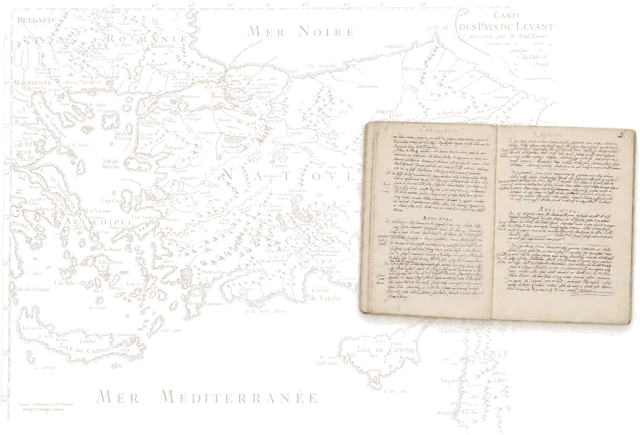
Levantine Lives exists to make the lives of the Christian communities of the Ottoman Holy Land accessible as widely as possible. Who they were, what they went through, how they evolved. What they lived through remains scattered. The Church recorded it in its registers, the Ottoman court in its rulings, the convent in its accounts, travellers in their writings. Levantine Lives is the only base to bring these worlds of sources together, act by act.
A researcher can now follow a single family across these voices. Every statement stays traceable to the folio that establishes it. The corpus grows collection by collection. New registers, new rulings, new accounts, new writings join the first ones, as research moves forward.
Events
84 epidemics, wars and affairs, 532 people linked to them
Families
2,662 families reconstructed, every link backed by its act
Decade by decade
30 decades documented by 38 registers and 31 books
Places and collections
32 parishes, villages and quarters, read in 69 archival collections
What the atlas holds
- 116,913published acts
- 607,550names found in the acts
- 14,798reconstructed people
- 84documented events
Figures as of 5 October 2026.
Four examples
-
An act · Bethlehem, 1653
Catharina, daughter of Franciscus
The act gives plague as the cause of her death. Excommunicated for uniting with Isahac without a blessing, she is buried outside the new cemetery.
-
A life · Bethlehem, 1656
Franciscus, son of Isa, known as Abu Khalil
He testifies before the Custody: “I, Francesco, aged 65, father of Caterina…”. His burial act calls him Turcimannus.
-
An event · Bethlehem, 1740-1741
The Bethlehem war
Margarita dies under a collapsed oven. At Christmas, the feast cannot be held with its solemnities: the friars left in the convent celebrate it in the Grotto.
-
A story · Bethlehem, 1781
The leaven rite
The priest comes to check at the door: nothing. The moment his back is turned, the leaven goes on the capital.
What we are working on right now
The latest notebook
The Christ Child at the Pasha’s, Bethlehem 1635
24 September 2026
Bethlehem, 3 June 1635: a pasha takes the Franciscans’ statue of the Christ Child home. He asks for a hundred piastres, and returns it for four robes.
The latest corrections
- Baptism, 1785, Bethlehem 5 October 2026
- Baptism, 1787, Bethlehem 5 October 2026
- Baptism, 1788, Bethlehem 5 October 2026
Coming next
- Parish registers: 46% of acts linked to a record
- Sharia court registers: 4.9% of acts linked to a record
- 31 Jerusalem court registers being transcribed
- 2 Ottoman fiscal censuses, from 1527 to 1562, being examined
- 3 manuscript account books from the Franciscan convent, 208 pages, being transcribed
- 152 works in the library, examination under way
Who builds this atlas
Levantine Lives is a French non-profit association (loi 1901), independent of any university. Its purpose: making the lives of the Ottoman Holy Land’s Christians accessible, with the provenance of the sources that establish them. The programme is led by two researchers: Thomas Issa directs the research, Munevver Esma Oztop handles its Ottoman palaeography. Four instruments assist them: transcription, identities, events, economic data. Each proposes, a person decides.
Support the research
Hundreds of thousands of pages are still waiting to be read
Your donation funds their reading: transcribing, translating and linking every act.
Secure payment on HelloAsso.
Write to us
Research under way, a collection to point out, an access request: leave us a note and your address.
Questions we are often asked
When will the atlas be available?
We aim to open it to the public in the first quarter of 2027. We are still linking the mentions of each person from one act to the next: as of 5 October 2026, 46% of the acts in the parish registers are already linked to a record.
How much data will the atlas hold?
As of 5 October 2026: 116,913 acts, 14,798 people and 2,662 families, from 1500 to 1799. Every register transcribed adds to them.
Which collections does it cover?
The parish registers of St Saviour's in Jerusalem, St Catherine's in Bethlehem and ʿAyn Kārim, the Jerusalem sharīʿa court, chronicles, Ottoman tax registers and convent accounts: 69 collections to date.
In which languages?
The site reads in French and English. The acts keep the languages of their sources: Arabic comes first, with more than half of the published acts. More than seven published acts in ten are in Arabic, Latin or Italian. Most of the rest are in French, Dutch, Spanish, English and German.
What will I be able to do with it?
Search for a person by name, follow them from one act to the next and go back to the folio that records them. Franciscus, dragoman of Bethlehem, can be followed this way from the priest’s register to a chronicler’s pages.
Will I be able to cite an act or a record?
Yes. Every record already carries its permanent link, and its own citation comes with the opening. The programme can be cited today: the reference is just below.
Will I be able to reuse and share the data?
Yes, under a CC BY-NC-SA 4.0 licence: free to share and adapt, with credit, for non-commercial use and under the same licence. The original acts are in the public domain.
Will access be open?
Yes. Consultation will be open, as this page and the Atlas, Method and About pages are today.
How can I follow progress or be notified?
The block “What we are working on right now”, higher on this page, follows every corpus update (latest: 5 October 2026). To be notified of the opening, write to [email protected].
How can I contribute or point out a collection?
Write to us just above and choose “An archival collection to point out” or “A scholarly collaboration”. Archives, Churches, researchers: every new collection links more lives together.
How to cite
Levantine Lives. Levantine Lives: A Historical Atlas of Christian Communities in the Ottoman Holy Land, 1500-1799. Ottoman Holy Land Data Project, 2026. https://levantinelives.org.
Enter the atlas
Preview
If you hold an access password, enter it to browse the whole site.
No access yet? Ask for it
An act · Bethlehem, 1653
Catharina, daughter of Franciscus
Buried in Bethlehem on 1 September 1653.
A life · Bethlehem, 1656
Franciscus, son of Isa, known as Abu Khalil
Catharina’s father, dragoman of the Custody, c. 1591-1662.
An event · Bethlehem, 1740-1741
The Bethlehem war
Two Catholic factions clash: the “nation” of the dragomans against Salomone’s party.
A story · Bethlehem, 1781
The leaven rite
The ban issued under precept on 29 September 1781, the stones thrown, and the wedding held all the same.
Contact
Write to us
Research under way, a collection to point out, an access request: leave us a note and your address.
Support the research
Hundreds of thousands of pages are still waiting to be read.
Your donation funds their reading: transcribing, translating and linking every act.
Contact
Share documents
A register, a family collection, an archive the atlas does not yet read: tell us where it is held and what it contains.