Levantine LivesA Historical Atlas of Christian Communities in the Ottoman Holy Land, 1500-1799
A world, act by act.
Why this atlas exists.
Levantine Lives exists to make the lives of the Christian communities of the Ottoman Holy Land accessible as widely as possible. Who they were, what they went through, how they evolved. What they lived through remains scattered. The Church recorded it in its registers, the Ottoman court in its rulings, the convent in its accounts, travellers in their writings. Levantine Lives is the only base to bring these worlds of sources together, record by record. A researcher can now follow a single family across these voices. Every statement stays traceable to the folio that establishes it. The corpus grows collection by collection. New registers, new rulings, new accounts, new writings join the first ones, as research moves forward.
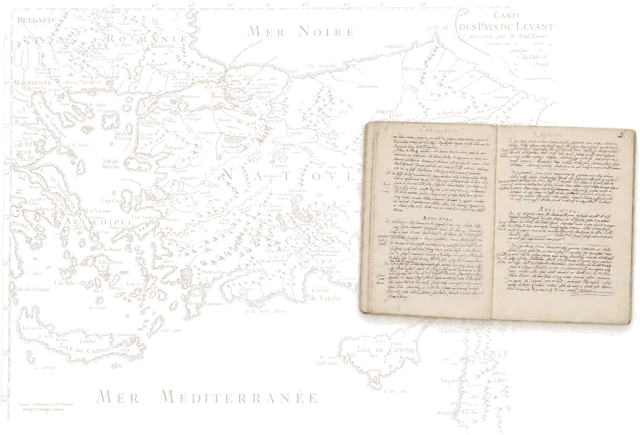
The documented events
84 documented events, 532 people linked
The reconstructed families
2,614 families named and reconstructed, browsable today
What the corpus demonstrates
30 decades documented across 33 registers and 27 works
The cited places
32 published places, 60 archival holdings processed
What the atlas holds: records, mentions, people, events.
- 87,733published records
- 486,624mentions of people
- 14,475reconstructed people
- 84documented events
Every figure is measured on the corpus published on this date.
The site opens soon.
The full atlas is in preview. If you hold an access password, enter it here to browse the whole site.
Write to us.
A question, an archive to point us to, or simply the wish to hear when we open : leave us a word, with the address where we should reply.
Behind the scenes
Who publishes this atlas
Levantine Lives is the Ottoman Holy Land Data Project. It is led by Thomas Issa, Founder and Research Infrastructure Director.
The atlas is published by Levantine Lives, association pour l’étude des communautés chrétiennes de Terre sainte à l’époque ottomane, a French non-profit association (loi 1901) seated in Nanterre, declared on 18 September 2026 with the Hauts-de-Seine prefecture. Its English designation is Levantine Lives, Historical Data on Christian Communities in the Ottoman Holy Land. Published data are released under a CC BY-NC-SA 4.0 licence.
How to cite
Issa, Thomas. Levantine Lives: A Historical Atlas of Christian Communities in the Ottoman Holy Land, 1500-1799. Ottoman Holy Land Data Project, 2026. https://levantinelives.org.
Questions we are asked
Is there a database transcribing Ottoman-era parish registers of Bethlehem and Jerusalem?
Yes. Levantine Lives transcribes the parish registers of Saint Saviour's, in Jerusalem, and Saint Catherine's, in Bethlehem. 87,733 acts are published as of 28 September 2026.
How many people are recorded, and over what period?
14,475 people are reconstructed, covering the period 1500-1799.
Who runs this project, a university or an independent researcher?
The Ottoman Holy Land Data Project is led by Thomas Issa, with no university affiliation to date. The atlas is published by Levantine Lives, association pour l’étude des communautés chrétiennes de Terre sainte à l’époque ottomane, a French non-profit association (loi 1901) declared on 18 September 2026 with the Hauts-de-Seine prefecture.
Is the site open access or does it require an account?
The entry page is open, no account required. The full corpus remains under controlled access while the data reconciliation is under way.
Can an individual record from this database be cited in an academic article?
Not yet: individual records will be citable once the corpus is open. Only a reference to the programme as a whole is available today.
What is the data license, can it be reused?
Data are published under a CC BY-NC-SA 4.0 licence.
Does this database cover Arabic-language registers, or only Latin and Italian ones?
The corpus includes 46,912 acts in Arabic, 14,847 in Latin and 6,342 in Italian, out of 87,733 acts.
Can I find a Christian ancestor from the Holy Land before 1900 on this site?
The corpus covers 1500-1799 with 14,475 reconstructed people. Name search lives in the full corpus, not on the entry page.
What sets this apart from a standard genealogy site?
Every fact stays traceable to its source, down to the folio that establishes it.
Is the site current, when was the data last updated?
Corpus last updated: 28 September 2026.
How can I be notified when the full atlas is released?
The corpus opens in stages, as the data reconciliation moves forward. Write to [email protected] and you will be told when the full corpus opens.