Story · Customs and beliefs
Leaven Above the Door: A Priest Against a Wedding Custom, Bethlehem 1781
Cite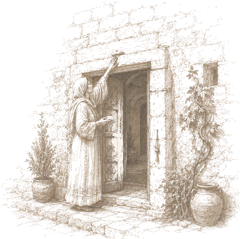
In Bethlehem, a custom went with weddings. Leaven, the dough that makes bread rise, was placed at the top of the house door; the bride struck it, then the groom struck her hand, so that she would bear children. In the autumn of 1781, the Catholic parish priest, Fr. Bernardino di Carelli, decides to put an end to it. He tries with two couples, a month apart.
The first are Kalil and Maria. They marry on 23 September 1781, after nearly five years of betrothal: in December 1776, Maria’s father had received ten piastres and a handkerchief, the pledge that seals a betrothal. Before the ceremony, the couple promise the priest to give up the leaven. He tells what followed in a note, below the record of their betrothal:
ciò non ostante andai in persona per trovarmi all'ingresso della Casa, e si trovarono senza tale superstiziosa cerimonia. partito, che fui si sollevarono contro li Parochi e fatta uscire la donna Sposa misero il lievito lo battè e lo Sposo battè la mano della Sposa acciò porti figliuoli.Notwithstanding this, I went in person to be at the entrance of the house, and they were found without such a superstitious ceremony. Once I had left, they rose up against the parish priests and, having brought out the bride, they put the leaven, she struck it and the bridegroom struck the bride's hand so that she might bear children.
The priest is furious, and writes it straight away: “Such is the faith of the Bethlehemite rascals, without reason, without conscience, and half-Christians”.
Six days later, on 29 September 1781, he betroths a second couple, within one family: Hanna (John, in Arabic), son of Juseph Elkasis, and the daughter of Simone Elkasis. They belong to the same family: to marry, they needed a permission from the Church, obtained two years earlier, and deaths in the family delayed the betrothal. This time the priest does not wait for the wedding. Right after the handkerchief is handed to the bride’s father, he writes the ban into the record itself, as a formal order of the Church, what the register calls “under precept”:
Li fu proibito sotto precetto il lievito sopra la porta della Casa, il beletto ed il nacus con tutte le altre usanze superstiziose, ed inutili.They were forbidden under precept the leaven over the door of the house, face paint and the nacus, with all the other superstitious and useless customs.
At the wedding, on 22 October, the quarrel breaks out over something else entirely: the family wants to marry on the day it has fixed, without waiting for another couple. The bride’s brother shows the priest “every imaginable insolence”, stones fly at the window, then they ask his pardon, “at least in appearance”.
Two couples, one month, the same priest. The only ones we see defy him over the leaven are Kalil and Maria: the door stayed bare as long as he stood there, and the leaven took its place the moment his back was turned.
Cited sources
| Date | In the register |
|---|---|
| 1776 | BetrothalBSC-SPO-1776-i400-02 |
| 1781 | BetrothalBSC-SPO-1781-i442-02 |
Sources and method
- Betrothal register of the Latin parish of Saint Catherine of Bethlehem, Liber Sponsalium, microfilm 8189366: this is the volume behind the BSC-SPO siglum of the four records cited here, and this is where each one sits. BSC-SPO-1776-i400-02, image 400, folio 79. BSC-SPO-1780-i428-02, image 428, folio 133. BSC-SPO-1781-i442-02, image 442, folio 161. BSC-SPO-1781-i444-02, image 444, folio 165. The corpus gives these records no number: they are located by image and folio.
- The ban clause is written into thirty-seven betrothals out of sixty-seven between 1780 and 1783, and into twenty-four out of twenty-nine from September 1781 onward. Its first written form dates from 26 June 1780 (BSC-SPO-1780-i428-02).
- Year: the transcribed heading reads “li 29. 7bre 1782”; a re-reading of the image corrected the year to 1781 (no closed loop on the last digit, continuous foliation between two pages of 1781). The date carried by the corpus, and followed here, is 29 September 1781.
- Uncertain reading in BSC-SPO-1776-i400-02: one word of the sentence describing the rite is undeciphered; the passage quoted does not contain it.
- Uncertain reading: ssolote, in the record BSC-SPO-1776-i400-02 (“10. Piastre ssolote, col facioletto”), the kind of the ten piastres.
- Uncertain reading: finestra, in the record BSC-SPO-1781-i442-02 (“Gettarono pietre alla finestra”).
- The priest signs “Fr. Bernardino di Carelli” in the record of 29 September 1781 and “Fr Bernardino da Carelli” below the 1776 record; this piece follows the 1781 record.
Ottoman Holy Land Data Project, "Leaven Above the Door: A Priest Against a Wedding Custom, Bethlehem 1781," accessed 19 November 2026, https://levantinelives.org/en/histoires/levain-chapiteau-porte-bethleem/. Corpus version: 18 November 2026 (ref. ae6a8cb6).
Cite this page
Reference (Chicago style).
Ottoman Holy Land Data Project, "Leaven Above the Door: A Priest Against a Wedding Custom, Bethlehem 1781," accessed 19 November 2026, https://levantinelives.org/en/histoires/levain-chapiteau-porte-bethleem/. Corpus version: 18 November 2026 (ref. ae6a8cb6).
See the BibTeX and RIS formats
@misc{levantine_levain_chapiteau_porte_bethleem,
  title        = {Leaven Above the Door: A Priest Against a Wedding Custom, Bethlehem 1781},
  author       = {{Ottoman Holy Land Data Project}},
  year         = {2026},
  howpublished = {https://levantinelives.org/en/histoires/levain-chapiteau-porte-bethleem/},
  note         = {Snapshot 2026-11-18, hash ae6a8cb6ff53+37ea22, id levain-chapiteau-porte-bethleem},
  urldate      = {2026-11-19}
}
TY - DATA TI - Leaven Above the Door: A Priest Against a Wedding Custom, Bethlehem 1781 AU - Ottoman Holy Land Data Project DA - 2026/11/18 PY - 2026 UR - https://levantinelives.org/en/histoires/levain-chapiteau-porte-bethleem/ ID - levain-chapiteau-porte-bethleem N1 - Snapshot 2026-11-18, hash ae6a8cb6ff53+37ea22 Y2 - 2026-11-19 ER -
Support the research
Hundreds of thousands of pages are still waiting to be read
Your donation funds their reading: transcribing, translating and linking every record.
Secure payment on HelloAsso, to the Levantine Lives association.