Levantine Lives
Method
Parish registers, qadi court deeds, chronicles, tax surveys, convent accounts: five ways of naming a person, and here is how they are brought together.
The sources
Five families of sources, no common identifier.
Hundreds of thousands of pages, often poorly scanned, most never translated. Each family of sources names people in its own way.
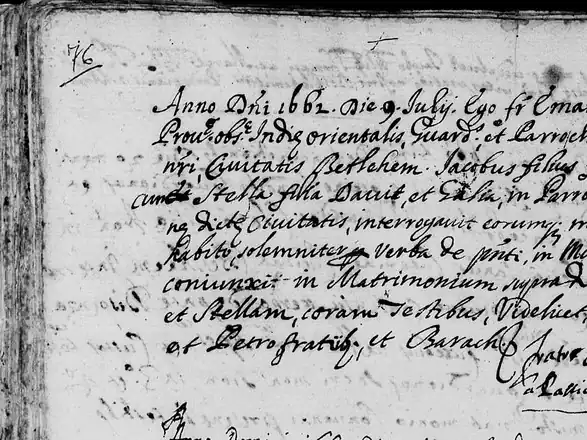
A Latin marriage record, 9 July 1662.
Bethlehem, St Catherine, fol. 76 (film 8189366, image 165)
Latin parish registers
1555-1799 · 11 holdings
Baptisms, marriages, burials, status animarum. A person appears under a Latinised first name, with a short filiation and a declared age.
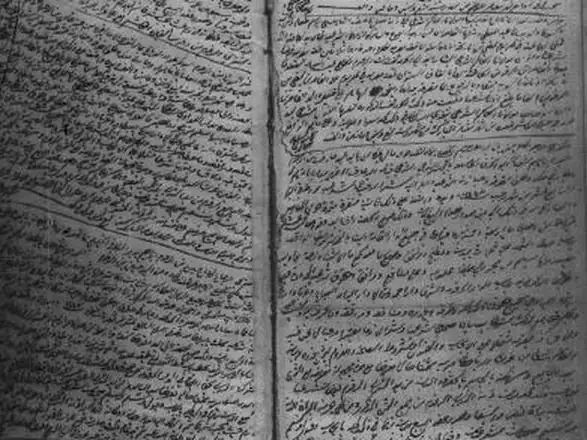
An open court register, in Arabic.
The sharīʿa court
1542-1703 · 27 holdings
Divisions, sales, debts, powers of attorney. A person appears by a three-link nasab (their name, their father’s, their grandfather’s), a quarter, witnesses.
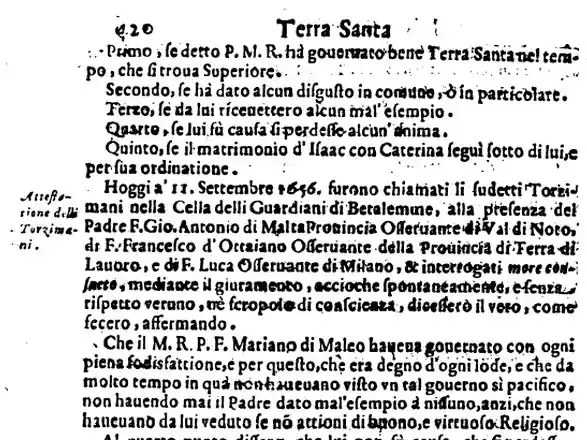
A printed page: the sworn statement of the Bethlehem dragomans, 11 September 1656.
Morone da Maleo, Terra Santa nuovamente illustrata, 1669, part II, p. 420
Chronicles
1500-1799 · 27 holdings
Custody narratives, sworn depositions, printed polemics. A person appears in an affair, sometimes through their own deposition.
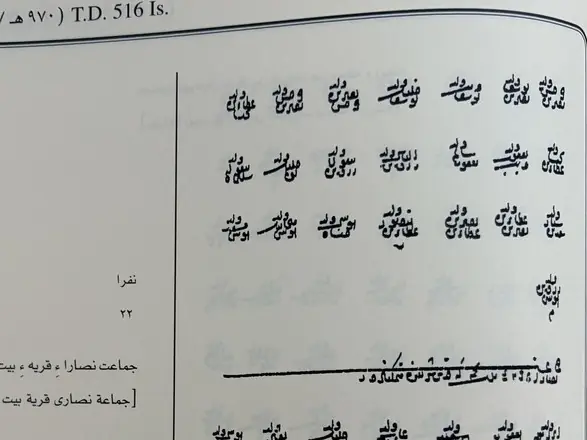
An Ottoman tax survey, village by village.
Defter TD 516, AH 970 (1562-1563), edition
Taḥrīr registers
4 holdings
The taxable Christian households of the liwāʾ of Jerusalem, village by village. A person appears in a household, tied to a village and to tax.
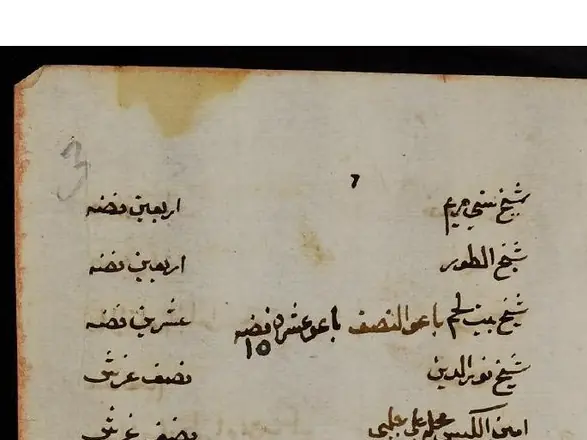
A list of payments, recipient by recipient, in Arabic.
Gotha, Ms. Orient. A 1536, fol. 3r
Convent accounts
being transcribed
Wages, purchases, lodging of pilgrims. A person appears through a trade, a payment, an employer.
Where the images come from
Latin parish registers
A Latin marriage record, 9 July 1662.
Bethlehem, St Catherine, fol. 76 (film 8189366, image 165)
The sharīʿa court
An open court register, in Arabic.
Chronicles
A printed page: the sworn statement of the Bethlehem dragomans, 11 September 1656.
Morone da Maleo, Terra Santa nuovamente illustrata, 1669, part II, p. 420
Taḥrīr registers
An Ottoman tax survey, village by village.
Defter TD 516, AH 970 (1562-1563), edition
Convent accounts
A list of payments, recipient by recipient, in Arabic.
Gotha, Ms. Orient. A 1536, fol. 3r
The languages
More than seven published acts in ten are in Arabic, Latin or Italian.
Out of 116,913 acts.
A bilingual act goes into “Other”. The language is that of what is read: the defters, written in Ottoman, are read in an Arabic edition.
The sources
What the search does with a name.
A name search starts from what you type and looks for two things: the spellings that begin with your entry, and the forms that a correspondence table links to that name, form by form, each one approved by hand.
It never brings two names together by how they sound, and it invents no equivalence. Some pairs that look close are deliberately held apart: Anna is a woman’s first name, Hanna is the Arabic form of John. Searching one will never return the other.
The “Exact” switch on the search screen goes back to the typed spelling alone.
What this requires
- Read the whole act: date, parents, godparents, place.
- Join two names into one person only on evidence.
- Record, for every link, its degree of certainty.
The work
Four operations, in this order.
01Transcribe
One image, one reading, with no prior assumption about the content of the act. Verbatim kept: spelling not modernised, abbreviations not expanded, illegible text in brackets. A doubt written by the friar is kept as it stands.02Translate
Each act receives its translation, beside the verbatim. Names keep the spelling written in the act.03Break down
Each act is broken down into what it states: the people, with their role, filiation, age, trade and community; places, dates, sums and goods; what the scribe adds to the formula. Every element keeps its provenance.04Link
The names found in the acts are brought together into people, then families: the filiation written in the act first, then the attested social circle, then the chronological constraint. A rare first name is not enough.
The system
From image to record.
The image
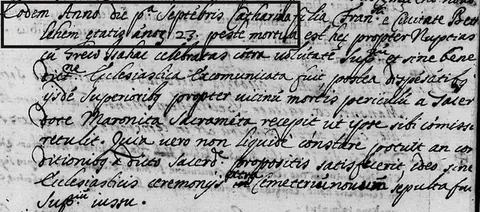
The line read (enlarged)

The record
Catharina, daughter of Franciscus
Death · 1 September 1653 · aged 23
Cause of death: plague
Liber Defunctorum of St Catherine’s, folio 88. Film 8189367, image 333.
01
Automated reading
A model reads the images and structures the fields, with no prior assumption about the content of the act. Each transcription shows what it is: checked by a person, automatic, or of unrecorded origin. The verbatim stays displayed beside it.
02
Review, case by case
An automatic process gathers the names that may belong to one person and opens a case. A person examines it piece by piece and rules out the other candidates one by one. Every merge is that person’s decision. A field that looks misread suspends the case until a person reopens the folio and decides: confirmed, corrected or illegible.
03
Checks before validation
Each completed batch of identities is audited before validation, through a documented random draw whose seed is recorded and can be replayed. A single error sends the whole batch back for review.
Every conclusion records the act fields it depends on. If one of them is corrected, a date re-read or a source requalified, the conclusion reopens along with every link that relied on it, across several generations if need be. Every revision is dated in the Corrections Log.
The instruments and the safeguards
Four instruments assist this work. Each one proposes, a person decides.
Hanna · transcription agent
Builds the database from the historical texts: transcription, indexing and structuring of acts.
Elias · identity reconciliation agent
Links identities: identifies mentions that may name the same person.
Catharina · event reference agent
Documents major events: what happened, where, when, and to whom.
Barbara · economic data agent
Documents economic data: prices, property and chains of ownership.
Safeguards shared by all four instruments
Three rules apply to all four instruments without exception: a written, versioned doctrine, where every rule carries a number and a date of human decision; a random-sample audit, whose principle is published, before any publication; an automatic reopening of any conclusion as soon as a source it depends on is corrected. Every published conclusion carries a chain of proof leading back to the folio that establishes it.
The proof
What a statement carries with it.
Every fact goes back to the folio that establishes it, with its degree of certainty.
Three levels: act, mention, person
- The act. A single document: a baptism, a marriage, a death, a status animarum, a judicial deed. It carries its language, date, place, text and call number, down to the page: film and image for a microfilmed register, call number and folio for an edited corpus.
- The mention. One occurrence of a person inside an act: a name as a scribe wrote it, with the role that person played that day.
- The person. A reconstruction: several mentions brought together after examining the sources, the only level that results from reasoning. Each published kinship link carries its justification: the act that establishes it.
A reconstructed family carries its fingerprint: a code computed from the data its opening decision rested on. If any of those data change, the fingerprint changes with them and the decision is reviewed.
Two scales of status
The first states the certainty of an identity or a link, shown relation by relation.
- Demonstrated. For a link, the source states it. For an identity, which no act states in so many words, three criteria together: every other candidate ruled out, a chronology that forces the identification, a kinship stated by the act.
- Probable. Converging evidence supports it without stating it. For an identity, the same demonstration, with one link resting on an estimated date, a less reliable source or the social circle.
- Plausible. An open hypothesis. A plausible identity is not published.
The second states how a person is tied to a historical event. The first investigated events are published.
- Documented impact. The source writes what this person went through.
- Actor in the event. The source names this person among those who carried the event out.
- Probable exposure. The person is attested where the event is demonstrated, within its dates; the source does not say what they lived through.
- Contemporary context. The person was alive during the event, outside the demonstrated area or with no attested presence.
Both scales are shown together and read separately: a probable identity can carry a documented impact, a demonstrated identity a mere contemporary context.
Not all sources prove things the same way
A register kept on the spot at the time of the events, the scholarly edition of that register, a contemporary’s chronicle, and a study published today do not read the same way. Every fund displays its nature.
Two funds carrying the same register still count as a single piece of proof: a copy, a late index, a reprint or a second parallel series of the same register never counts as a second witness. An act taken from an abstract carries no verbatim and never supports a link on its own.
Some published units are not register acts but passages from books, cut out one by one and flagged as such.
What the site publishes
The scope is written series by series: the selection runs to 1703 for the court. The sijills and defters also name Christians of other Churches, usually without their rite. The Greek and Armenian patriarchal archives remain outside. Beyond these limits, a blank reflects the selection.
The published scope is the one stated in the subtitle: acts dated within the announced period. Acts of the corpus falling outside it stay in the working database and are counted on the Coverage page, but are not served.
A separate rule forbids publishing any data naming a person who could still be alive. It applies to the result of the publication filter, not only to the table of people.
What remains to be done
Six workstreams.
Quality control conditions all the others.
01Complete the database
69 collections have been processed to date. Transcription of the rest continues: court registers, defters, convent accounts, books.02Complete the linking
Link each of the 607,550 names found in the acts to a person, series by series, with their places, events and economic data. As of 5 October 2026, 46% of the acts in the parish registers are already linked to a record.03Quality control
Re-read, check, test. Identities are already audited batch by batch. The next step is to measure transcription error on names and dates, through an outside review of randomly drawn batches.04Work on the analysis
Move from cross-referencing to results, on the questions below.05Extend
Process new collections, and carry the corpus beyond 1799, to the end of the Ottoman period.06Deposit the data
A long-term archival deposit is in preparation.
Open questions
The questions the atlas sets out to answer.
The major questions about these communities, on which the acts bring new material.
Demography
How many Christians lived in the Holy Land, and how did their numbers change from the sixteenth to the eighteenth century, through its crises?Confessions
How were the boundaries between Churches drawn in daily life: Latins, Greek Orthodox, Greek Catholics, Maronites, Armenians, Syriacs, Copts, Ethiopians?Law and Ottoman society
Why and how did Christians turn to the qadi’s court? What place did they hold in the Ottoman fiscal and legal order over the years?Economy and trades
What did these families live on? Trades, wages, prices, goods, and the place of service to the Custody in those incomes.Missions and powers
What did the presence of the Franciscan Custody and the European powers change for families: employment, protection, conversion?The Custody and its parishes
How did the friars shape parish life, from the sacraments to reconciliations and the campaigns against local customs?Families and solidarity
How were alliances, godparenthood and migrations made, and what do they say about local solidarity?
Does one of these questions meet yours? Write to us.